← Back to Reading the landscape
What this layer is
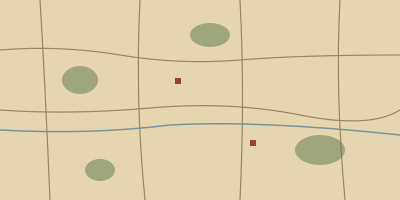
The Ordnance Survey County Series was the first really detailed national mapping of Britain, with the first edition for this area surveyed in the 1870s and 1880s and revised around the turn of the 20th century. At 6 inches to the mile (later 25 inches) they show an astonishing level of detail: every hedgerow, every pond, every farmstead, every footpath, every woodland — often with individual tree clumps marked. They are the best single record of what the working rural landscape looked like before the arrival of mechanisation, artificial fertiliser and the hedgerow removals of the mid-20th century.
The National Library of Scotland has digitised and georeferenced the full series and made it freely available. The cluster's analysis platform aligns those historic sheets with today's OS mapping, so you can slide between 1890 and 2026 at the same scale.
What it reveals in this catchment
Across the Upper Medway, the historic sheets show several consistent patterns that matter for land management today:
- Denser hedgerow networks. Many fields that appear as single enclosures today were subdivided into two, three or four smaller parcels in the Victorian era. Those lost hedges are typically the ones land managers later wonder whether to reinstate.
- More ponds. Most holdings had multiple stock ponds before mains water reached rural areas. A high proportion have been infilled, drained or fallen into neglect. Many show up clearly on the historic maps and can often still be identified on the ground.
- Different woodland edges. Coppice boundaries shift over time. The historic maps often show extended scrubby margins around woods that have since retreated to a hard edge.
- Orchards. The High Weald had far more orchards — cider, table fruit, damsons — than remain today. Many of the small square patches on historic maps that look like gardens are actually traditional orchards.
- Lost watercourses. Small springs and ghyll heads are often shown on the historic maps with names that have since been lost. They usually still flow.
What land stewards can do with this
- Restore lost features. A hedgerow or pond shown on the 1890 map is almost always the right place to put one back. The Victorian surveyors were very good at reading drainage, shelter and land use.
- Make a convincing case. Historic maps carry real weight with grant bodies, local authorities and neighbours. “Reinstating the pond that was here in 1895” is an easier sell than “putting in a new pond”.
- Understand your holding's story. Most Upper Medway farms have been farmed in some form for centuries. The Victorian snapshot is close enough in time that much of what was there is still recoverable, and the map is a direct link to the people who knew the land best.
Data source: Ordnance Survey County Series, 1st and 2nd editions, sourced via the National Library of Scotland under a Creative Commons licence. Georeferencing and overlay rendering by the cluster's ecology platform.